
“Trust me.”
Leaders say it like a magic spell. A verbal fast pass. A shortcut around uncertainty.
But here’s the awkward truth: trust is not a default setting. Most humans do not hand it out like free samples at Costco. Trust is earned slowly, validated by evidence, and revoked instantly when your actions stop matching your words.
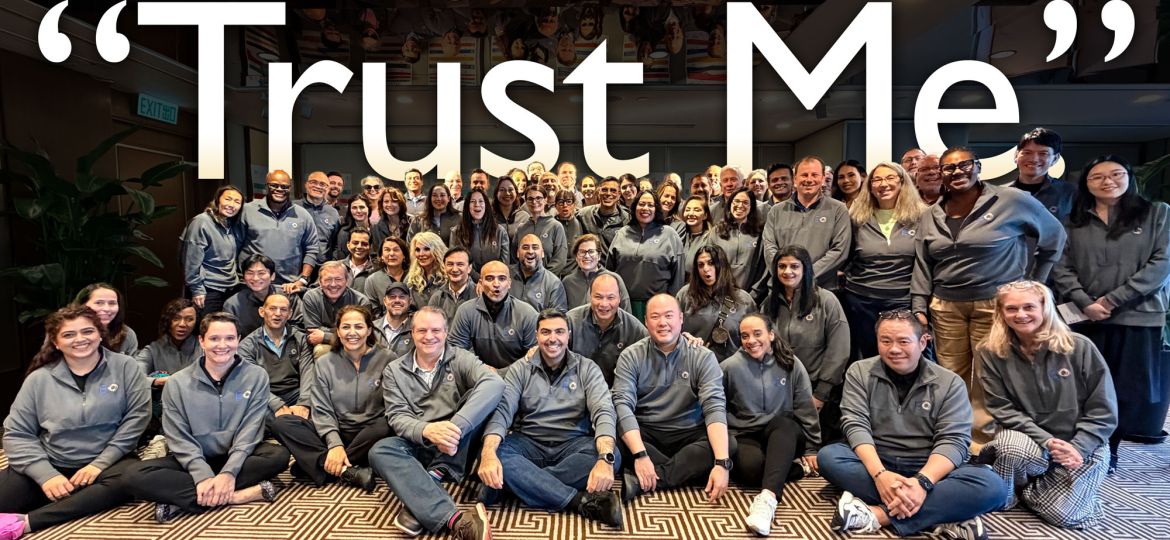
That showed up clearly for me last month in Hong Kong while facilitating EO’s Integrated Strategy Meeting (ISM). In a room full of high-capacity founders and global leaders, nobody needed more IQ. They needed more safety and more signal. More proof that speaking honestly would not cost them status, relationships, or future opportunity. And as the chair of the team leading the meeting for our organization’s most senior leaders, I needed to trust in my team just as much.
Trust is built the same way everywhere: not through declarations, but through deposits.
Trust is a pile of small, boring actions (and that’s the good news)
If trust were built mostly through speeches, CEOs would be the most trusted people on Earth and toddlers would be the least. Reality offers the opposite data.
Trust grows through consistency in the tiny moments:
- You do what you said you’d do.
- You admit what you do not know without theatrics.
- You keep a confidence.
- You give credit fast and blame slow.
- You tell the truth early, before the truth becomes a crisis.
In my coaching work, we frame this as “Elevating Relationships,” where psychological safety is the precondition for people to take the interpersonal risks required for real teamwork. In healthy cultures, people feel safe to say the hard thing for the greater good of the business.
This is why “courage to speak your truth about what is working and what is not working for the greater good of the business” is such a powerful facilitation standard. It is not motivational fluff. It’s a trust-building protocol.
 That’s when I saw it happen, back in that room in Hong Kong at the EO ISM meeting. It took a day of connection building and invitations to take a chance with an open question. From the side of the room came the question. A hand not often seen raised in the air went up just then, from a voice not normally heard from. Empowered by the self-confidence to ask a big question in a room of their peers and working partners. It moved the room and the conversation forward. The group respected the question, and the individual trusted the room. That’s what it looks like and to me I knew we were making progress.
Psychological safety is not “be nice” (it’s “be real and stay connected”)
Google’s Project Aristotle famously found that the strongest predictor of team effectiveness was psychological safety: people feeling safe to take interpersonal risks like asking questions, admitting mistakes, and challenging ideas. Google Rework
Amy Edmondson’s foundational research defines psychological safety as a shared belief that the team is safe for interpersonal risk-taking. Massachusetts Institute of Technology
So no, it’s not about lowering standards or avoiding conflict. It’s about creating the conditions where conflict becomes useful instead of personal.
One of the most practical lenses used with leadership teams is the SCARF model: Status, Certainty, Autonomy, Relatedness, Fairness. When any of those are threatened, people get weird. Quiet. Defensive. Controlling. Performative. Or all four at once. NeuroLeadership Institute
Trust-building leaders learn to reduce threat signals and increase reward signals, especially in tense conversations.
Trust is also built in how you listen: curiosity versus judgment
A trust gap often isn’t created by what you say. It’s created by how you hear.
When leaders listen like judges, people speak like defendants. Short answers. Minimal risk. Polished stories. No surprises.
When leaders listen like curious scientists, people speak like collaborators. They share raw data. Half-formed thoughts. Real obstacles. And the truth arrives sooner.
A simple tool here is the Ladder of Inference: we all jump from data to assumptions to conclusions faster than we realize. Curiosity slows the jump. Harvard Pon
Two trust-building moves that feel almost unfairly effective:
- “What am I missing?” (forces humility without self-flagellation)
- “Say more about that.” (signals safety and attention)
This is where trust becomes a behavioral choice, not a personality trait.
The “trust stack”: where trust actually lives
Most leaders talk about trust like it’s one thing. It’s not. It’s a stack:
- Trust in self: If you do not trust your own judgment, boundaries, and follow-through, you will compensate with control or avoidance. Either one erodes trust downstream.
- One-on-one trust: This is reliability plus care. In research terms, trustworthiness often clusters around ability, benevolence, and integrity. Academy of Management Journals
- Across teams: This is where “good intentions” die without coordination. Trust across teams requires clear agreements, clean handoffs, and fast repair when you drop the ball.
- Organizational and brand trust: The culture gets a vote. Policies, incentives, and leadership behaviors teach people what’s actually safe, regardless of what the values poster says.
All four of these ideas were in my mind as I picked up the mic and stepped to the front of the room in Hong Kong at the EO Integrated Strategy Meeting, with 70 professional and entrepreneurial leaders from around the world stared back at me, waiting for what I had to say. I knew that this opening keynote needed to build trust in our organizational strategy, between the 20 teams represented in the room and with the individuals on my own team who were responsible for organizing this meeting.
 And I needed to trust myself most. In the past, I might have just avoided being in that position in the first place, but that is the responsibility of saying “yes” to leadership. It comes with the burden of approaching important situations without the certainty of outcome. So, I leaned on what I’ve learned about trust, to simply trust that I had approached this meeting and it’s importance with good judgement, informed decision making and the needs of others ahead of mine. And to trust that the people in that room would listen with positive intent and openness. Through the rest of meeting we leaned into our core values and our trust in one another to be better, together.
Best practices that actually move the needle on the “Trustometer”
Here are trust builders that hold up across research, facilitation rooms, and real businesses:
- Model vulnerability first. Not oversharing. Just appropriate truth at the right altitude. This aligns with the idea that trust enables people to take risks and speak candidly for the greater good.
- Make promises smaller and keep them. Consistency beats intensity.
- Create explicit norms for conflict. Psychological safety lets teams challenge ideas without attacking identities. Google Rework
- Close loops fast. Nothing rots trust like unanswered questions and “we’ll get back to you” that never returns.
- Repair quickly when you miss. A clean apology plus a changed behavior is jet fuel for trust.
If you want a clean weekly experiment: pick one meeting and make it a “psychological safety lab.” Ask one question that invites dissent, thank the dissent out loud, and protect the person from social penalty in the moment. Once you get past that meeting, just find ways to integrate these conversations into your regular meetings and watch what happens to your culture. It’s not the table tennis and nitro-coffee dispensers that build culture, it’s trust.
The unifying idea: replace “Trust me” with “Test me”
Trust isn’t a vibe. It’s not a title. It’s not a speech.
Trust is the accumulation of observable evidence over time: alignment between what you say, what you do, and how you listen.
So the next time “Trust me” wants to come out of your mouth, try this instead:
“You don’t have to trust me yet. Just watch what I do and let me know then.”
That sentence forces the only path that actually works.
And it makes trust inevitable.


